Hot Drink Inc In development
A business tycoon game · in development

Hot DrinkInc.

Start behind the counter. End up on the board.

You open one cafe. You set the price, pick the blend, hire the baristas and put out every fire yourself. Then you start buying your way upward: a manager, a second city, an office, a C-suite. You keep going until the thing you built runs without you.

  • Windows
  • macOS
  • iOS
  • Android

No release date yet. Built in Unity, in the open.

Automation buys altitude

That is the whole design, in three words. Every purchase you make should delete a category of manual work and let you operate one layer higher: from task, to store, to city, to division. Nothing is ever taken away from you: the higher rungs unlock, they never force. You can stay a beloved single-store operator forever.

The delegation ladder

Five rungs, and each one
deletes the last one's friction.

The ladder isn't a tutorial track. It's an unlock graph. You climb it by choosing to, and every rung you buy is a category of weekly busywork you never have to do again.

  1. On site · manual

    Behind the counter

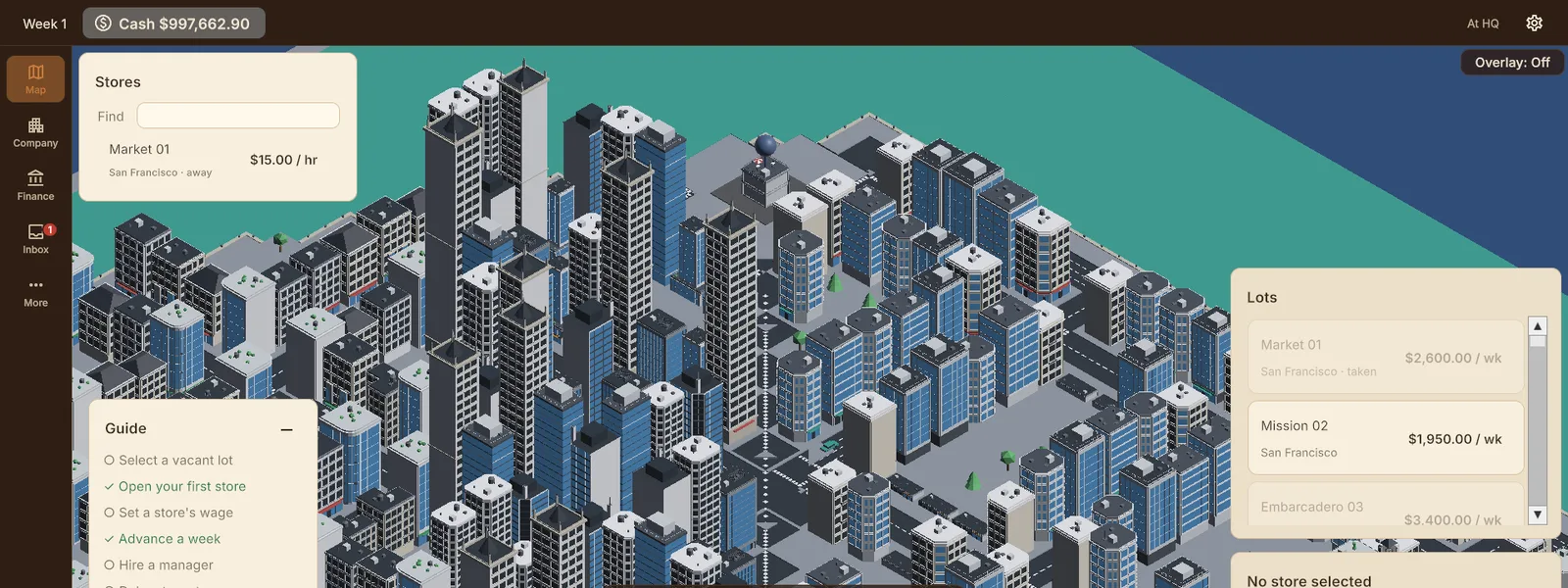
    One store, one city, all of it yours. Lease a lot off the map, weigh foot traffic against weekly rent, fit it out, buy a blend from a local roaster, set your menu prices, hire baristas and set their wage. Then end the week and see what the ledger says.

    The cost Every decision, every week, forever.

  2. Delegated

    Hire a manager

    Put a manager on the store and hand them the week. From then on the store's routine decisions are made for you, to a policy you set. The simulation resolves that store exactly the same way it would if you'd made every call yourself. Delegation is a decision source, not a lesser economy.

    Deletes per-store weekly micromanagement → you now run a company, not a counter.

  3. Multi-city · the hard rung

    Open a second city

    Growth bites back. A second and third store means stores that eat each other's catchment if you space them badly, rivals fighting you for local share, and travel. Some things still need you physically present, and now "present" is a flight away. This is the rung that hurts, and it's supposed to.

    Adds travel friction, cannibalisation, competition for share.

  4. Remote · departments

    Open an office

    Stop flying. An office in a city, staffed with departments (HR, Finance, Products), lets you run that city from anywhere. It also turns the three financial statements into something you actually read: income statement, balance sheet, cash flow, projected as pure functions over a real double-entry ledger.

    Deletes being somewhere → you run cities, not stores.

  5. Holding company

    Appoint a C-suite. Take it public.

    The top of the ladder is the point where the company outgrows you: executives and a board, an IPO, acquisitions, and divisions that have nothing to do with coffee any more: real estate, equities and venture bets, plantations that take you back to the bean, online services. You stop operating and start allocating.

    Deletes operating → you own the thing instead.

Rungs 1 to 4 are what the current build is proving out end to end. Rung 5 exists in the data model and lands as content, not new code. See where the build is.

Under the counter

A real simulation,
not a spreadsheet in a hat.

The economy runs headless. Money, demand, staff, time, rivals and incidents live in their own layer with no idea a screen exists. It can be tested without ever opening the game, and it behaves identically whether you or a manager supplied this week's decisions.

The week is the heartbeat

Everything resolves on a weekly tick with a quarterly roll-up: demand, wages, rent, restocking, rivals, incidents and the ledger, in one deterministic pass you can end whenever you're ready.

A bean market that moves

Roasters stock different blends city by city, and their prices drift week over week from a seeded market. Your margin is never a fixed number you solved once.

Lots, not menus

Sites are places on a stylized in-engine map, with traffic, rent and demographic overlays. It's the same map, offline, on every platform.

Staff who quit

Headcount, hourly wage, benefits and morale. Underpay a store and it tells you, loudly, in the week you can least afford it.

Rivals with a plan

Seeded competitors open near you and fight for share of the local catchment. So do your own stores, if you site them too close together.

Everything that happens, in one inbox

A barista walks out, an espresso machine dies, a customer complains. Every discrete event in the world flows through one bus, and lands somewhere you can act on it or deliberately ignore it.

Books that actually balance

A double-entry ledger underneath, with the income statement, balance sheet and cash flow derived from it, plus two separate pools of money, the company's and yours.

The world is data

Cities, currencies, roasters, blends, departments, incidents, laws and rival archetypes are all authored assets. Growing the game means authoring more of them, not writing more code.

Why this exists

Five things the genre
keeps getting wrong.

Faithful mechanics are the floor, not the pitch. These five are the reason to build the thing at all, and they ship as part of the game rather than as a patch later.

  1. Onboarding that watches you

    Guidance gated on what's actually true in the simulation, not a fixed script that blocks the screen. Skippable, replayable, and it walks the ladder with you.

  2. Undo in the interior editor

    Every placement, move, rotation, recolour and deletion is a reversible command. Multi-step undo and redo, revert to saved, and a cancel that doesn't cost you the layout.

  3. Find your own store

    A searchable, filterable directory that flies the camera to whatever you tap, plus markers you can always read, with badges when something needs you.

  4. An inbox, not a popup barrage

    Open problems sit in a list with their type, severity, city and deadline, resolvable inline or one tap from the thing they're about. You clear it in the order you choose.

  5. Landscape, and one UI everywhere

    Both orientations from a single interface: multi-panel when there's room, drawers when there isn't. Mouse and touch through one layer, with touch targets sized for thumbs.

Everywhere, from day one

Four platforms, one build discipline.

Cross-platform isn't a port planned for later. Every sprint has to compile for all four targets before it counts as finished. No desktop-only or mobile-only assumption gets to settle in.

WindowsDesktop
macOSDesktop
iOSPhone & tablet
AndroidPhone & tablet
  • Unity 6.3 · URP
  • Portrait & landscape
  • One responsive UI tree
  • 44pt minimum touch targets
  • Offline in-engine map
  • Headless, testable simulation
  • Status In development
  • Release No date
  • Build Vertical slice

Where the build actually is.

There's no store page, no wishlist button and no date to give you. Putting one here before it's real would just be a promise to break. What there is instead: a thin cut through every load-bearing system, being widened one sprint at a time.

The current slice

  • A stylized, navigable city map with rentable lots
  • Leasing, fit-out and running a store: blend, prices, staff, wages
  • The weekly tick, the ledger and a drifting bean market
  • Managers, delegation and travel between cities
  • Offices and departments, widening now
  • The C-suite, the board and the IPO: designed, not yet built

This page will change as the build does. There's nothing to sign up to yet; when there is, it'll be here first.

Questions

The obvious ones.

Isn't this just a copy of another coffee tycoon game?

It's an original game that remakes a genre's systems: the delegation ladder, the weekly economy, the market and the books. Mechanics and rules aren't ownable; a game's name, art, wording and interface are, and none of those are borrowed here. Every city, blend, roaster, department, icon and line of text in Hot Drink Inc is written for it. It isn't affiliated with, endorsed by or connected to any other studio's game.

When does it come out?

No date, and no estimate that would be honest to give. It's in active development and the scope is deliberately built so that content can expand without rewriting systems.

What will it cost?

Not decided, and not announced. Nothing about pricing or monetisation is settled yet.

Will the phone version be cut down?

No. It's the same game and the same interface, reflowed: multi-panel where there's room, drawers where there isn't, in both portrait and landscape. Every sprint has to build for all four platforms, so there's never a "mobile version" to water down later.

Does it need an internet connection?

The map is drawn in-engine rather than streamed from an online map service, specifically so the world is identical and available offline on every platform.

Can I follow development?

This page is the front door for now, and it gets updated as the build moves. Community links go here once there's somewhere worth sending you.